"My goods are worth 100,000 dirhams — how much customs will I pay?" There is no answer to that question. There is an answer per HS code.
It is the first question every importer asks, and the only one nobody can answer without one more piece of information: the tariff heading of the goods. In the Moroccan integrated tariff, import duty ranges from 0% to 200% depending on the tariff line. Two products leaving the same container, from the same supplier, can be taxed at 2.5% and at 30%.
This article gives the complete formula, a worked example from end to end, and shows where the money is actually lost: not in the calculation, but in the choice of code.

The amount you will pay out is decided long before the goods reach the port
1. The basis of assessment: the customs value
Before any rate, you need a base. In Morocco as in every WTO member country, that base is the CIF transaction value: what you actually paid, increased by everything it took to bring the goods to the point of entry into the territory.
What goes into the customs value
- The price actually paid or payable to the supplier, as it appears on the commercial invoice.
- International freight up to the first point of entry into Morocco (Casablanca, Tanger Med, Nador, Agadir, Mohammed V airport, and so on).
- Transport insurance. Where none was taken out, customs applies a flat-rate figure.
- Loading, handling and packing costs incurred upstream.
- Commissions paid to an intermediary, buying commissions excepted.
- Royalties and licence fees related to the goods, where their payment is a condition of sale.
What stays out — provided it is shown separately on the invoice
- Inland transport after the point of entry.
- Assembly, installation or technical assistance costs subsequent to importation.
- Finance charges under a deferred payment agreement, if invoiced separately.
- Moroccan duties and taxes themselves.
The common case: an EXW or FOB invoice
Most Asian invoices are issued FOB, many European ones EXW. Neither is a customs value: the CIF value has to be rebuilt by adding freight and insurance, with supporting documents.
This is a recurring friction point at clearance. A value rebuilt by guesswork, with no transport invoice behind it, invites a check. And an under-declared value is the second most common ground for reassessment, right behind misclassification.
2. The three lines of a customs invoice
An import liquidation reads on three lines, applied in this order. The order matters: each line changes the base of the next.
| Line | Base | Rate |
|---|---|---|
| Import duty (DI) | CIF customs value | Depends on the HS code: 0%, 2.5%, 10%, 17.5%, 30%, 40% and beyond |
| Parafiscal import levy (TPI) | CIF customs value | 0.25% |
| Import VAT | CIF + DI + TPI | 20% (reduced rates for certain categories) |
How the rates are actually spread
Across the 13,218 lines of the integrated tariff, import duty rates are not evenly distributed. Two rates on their own cover more than two thirds of the nomenclature:
2.5%
Roughly 6,600 lines. Industrial inputs, capital goods, raw materials, pharmaceutical products.
30%
Roughly 2,850 lines. Finished consumer goods, textiles, furniture, household appliances.
10% and 17.5%
Roughly 2,700 lines combined. Semi-finished and intermediate goods.
The rest — 40%, 50%, 100%, 200% — targets sensitive agricultural products, alcoholic drinks, tobacco, or goods under specific protection. What matters most is the geography of that distribution: the border between 2.5% and 30% very often runs through the middle of a single six-digit subheading. That is to say, in the last four digits, the ones nobody checks.
3. A worked example, end to end
Take an ordinary case: a Moroccan importer buys 200 kitchen extractor hoods from a supplier in Shanghai.
The starting figures
- Commercial invoice: USD 10,000 FOB Shanghai
- Sea freight to Casablanca: USD 800
- Transport insurance: USD 100
- Customs exchange rate used for the example: MAD 10.00 to USD 1
Step 1 — Rebuild the CIF value
10,000 + 800 + 100 = USD 10,900, that is MAD 109,000.
It is this value, not the MAD 100,000 on the invoice, that serves as the base. Leaving out freight and insurance understates the base by 9% — and that is exactly the kind of gap customs detects by comparing with the average freight observed on the Shanghai–Casablanca route.
Step 2 — Find the 10-digit code
Extractor hoods fall under heading 84.14 (air pumps, compressors, fans, extractor hoods). The international six-digit subheading is 8414.60: "hoods having a maximum horizontal side not exceeding 120 cm".
At six digits, all is well. At ten digits, the Moroccan nomenclature splits that subheading in two:
| 10-digit code | National wording | Duty |
|---|---|---|
8414601000 | Hoods… for domestic use | 30% |
8414608000 | Hoods… other | 2.5% |
Our hoods are intended for resale into residential kitchens: that is code 8414601000, at 30%.
Step 3 — Apply the three lines
| Line | Calculation | Amount |
|---|---|---|
| CIF customs value | — | MAD 109,000.00 |
| Import duty | 109,000 × 30% | MAD 32,700.00 |
| Parafiscal levy | 109,000 × 0.25% | MAD 272.50 |
| VAT base | 109,000 + 32,700 + 272.50 | MAD 141,972.50 |
| Import VAT | 141,972.50 × 20% | MAD 28,394.50 |
| Total payable at customs | MAD 61,367.00 |
Step 4 — Read the result as a landed cost
The cost of the goods delivered duty paid is MAD 170,367, that is MAD 851.84 per hood — against a supplier invoice of MAD 500 a unit. Customs has added 70% to the purchase price.
That is the figure to know before placing the order, not after. And it is the figure that moves completely if the code changes.
4. Why two neighbouring codes do not cost the same
Take the same container, the same invoice, the same customs value. Simply assume the declarant picks the other branch of the subheading, 8414608000 ("other"), because the wording "for domestic use" struck them as arguable.
8414601000 — domestic use | 8414608000 — other | |
|---|---|---|
| Import duty | MAD 32,700.00 | MAD 2,725.00 |
| Parafiscal levy | MAD 272.50 | MAD 272.50 |
| Import VAT | MAD 28,394.50 | MAD 22,399.50 |
| Total | MAD 61,367.00 | MAD 25,397.00 |
And the gap has to be read both ways. Declaring 8414608000 for household hoods means evading MAD 35,970 of duties and taxes: on the day of the check, that is the amount claimed, increased, and multiplied by the number of identical declarations filed since — the mechanism described in HS code error: reassessment, fine and how to challenge it. Declaring 8414601000 for genuinely industrial hoods means paying MAD 35,970 you never owed — and nobody will hand it back to you unprompted.
5. The reductions available
The integrated tariff rate is a ceiling, not a fate. Three levers let you pay less — and all three apply per HS code.
Free trade agreements
Morocco is bound by a dense network of preferential agreements: European Union, EFTA, United States, Turkey, United Arab Emirates, the Agadir Agreement, the Greater Arab Free Trade Area, AfCFTA.
Each agreement has its own list of eligible products and its own dismantling schedule, expressed in tariff headings. An agreement never says "machinery is at 0%": it says "heading 8414.60 is at 0% from such and such a year".
Proof of origin
Without a valid origin document, the preference falls away and the full rate applies — even where the product was entitled to it.
Depending on the agreement: an EUR.1 or EUR-MED certificate, an origin declaration on the invoice for small consignments, an A.TR certificate under the Turkish regime, a specific form for the Arab agreements. The document has to be presented at clearance, not chased afterwards.
Customs economic procedures
Temporary admission for inward processing, bonded warehousing, transit, drawback: these suspend or refund duties where the goods are meant to be processed and then re-exported.
They do not cancel the classification question — they move it. Each deserves an article of its own.
The trap: the preference follows the code
A wrong code does not only cost you a wrong rate. It can make you lose the tariff preference: if the declared code does not appear on the agreement's list, preferential origin does not apply, whatever EUR.1 you produce.
You then pay the full rate of a line your product does not belong to.
Duty, parafiscal levy, VAT — then the costs the customs liquidation does not contain
6. What this calculation does not cover
The three lines above are customs. They are not the cost of clearing. Budget also for:
- The freight forwarder's or customs broker's fees — per file, often with a minimum charge.
- Port and handling charges: THC, terminal fees, discharge.
- Storage and demurrage, which run by the day and become the first cost item as soon as a file is held.
- The domestic consumption tax (TIC), on energy products, drinks, tobacco, certain sugary products — triggered, again, by the 10-digit code.
- Technical checks and prior authorisations: ONSSA, conformity assessment for industrial products, import licences. They cost little in themselves, but they cost days.
- Bank charges tied to the documentary credit or the transfer.
A useful order of magnitude: on a standard containerised operation, these items regularly add 5% to 15% on top of the customs total. Build them into the landed cost from the supplier quotation onwards.
FAQ: calculating customs duties in Morocco
How do I find the import duty rate for my product?
You first obtain the 10-digit code, then read the rate against that line in the integrated tariff published by ADII. There is no shortcut: the rate is a property of the tariff line, not of the product family. Two references from the same catalogue can fall under two lines at different rates.
Is import VAT recoverable?
For a business registered for VAT in Morocco, VAT paid at import gives a right to deduction under ordinary conditions, on the basis of the customs receipt. It weighs on cash flow, then, not on margin. Import duty and the parafiscal levy are not recoverable: they are definitive costs that enter the landed cost.
What happens if customs disputes my declared value?
The administration can set aside the transaction value and rebuild the value using the substitution methods provided for by the WTO Customs Valuation Agreement — value of identical goods, then similar goods, then the deductive method, then the computed method. In practice, you are invited to justify: invoice, proof of payment, contract, freight invoice, insurance policy. A documented file defends itself; an invoice on its own, hardly.
Can I calculate the duties before placing the order?
Yes, and that is the right moment to do it. You need the product data sheet, the matching 10-digit code, and a freight estimate. The calculation then becomes a parameter of the supplier negotiation, just like the unit price. Doing it after the container arrives means enduring a figure instead of steering it.
Which exchange rate applies to my foreign-currency invoice?
The exchange rate used for conversion into dirhams is the one adopted by the customs administration for the clearance period, not the rate on the invoice date or your bank's rate. On a dollar invoice with a six-week transit time, the gap is not trivial: build a margin into your forecast calculations.
Does air freight change anything in the calculation?
The mechanism is identical, but the base rises sharply: since air freight enters the customs value, an urgent shipment can see its CIF value exceed the invoiced value by 30% to 50%. Duty and VAT follow mechanically. An air-versus-sea trade-off is therefore decided on the landed cost, never on transport cost alone.
Articles recommandés
The complete guide to HS codes in Morocco (Customs 2026, 6 and 10 digits)
Everything you need to know about HS code structure in Morocco, the 10-digit specifics, and how to avoid classification mistakes.
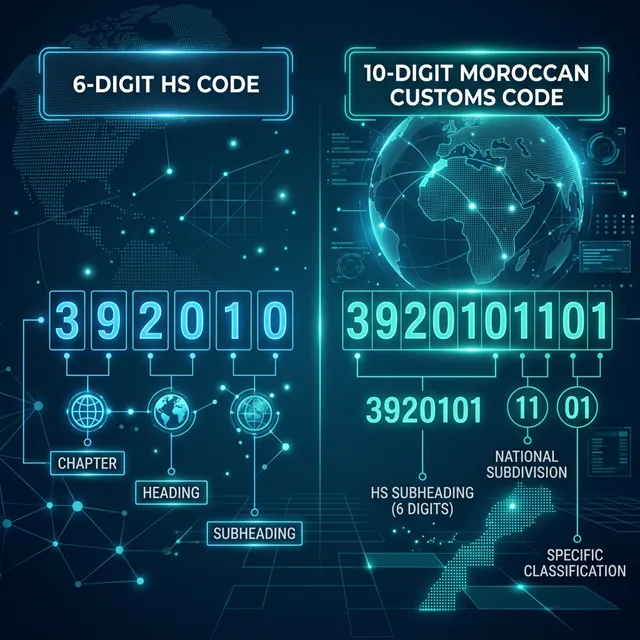
HS code 6 vs 10 digits in Morocco: what is the difference?
Understanding the distinction between the international nomenclature (6 digits) and the Moroccan national tariff (10 digits) to keep your imports safe.