Describe the product.
Get a code you can defend.
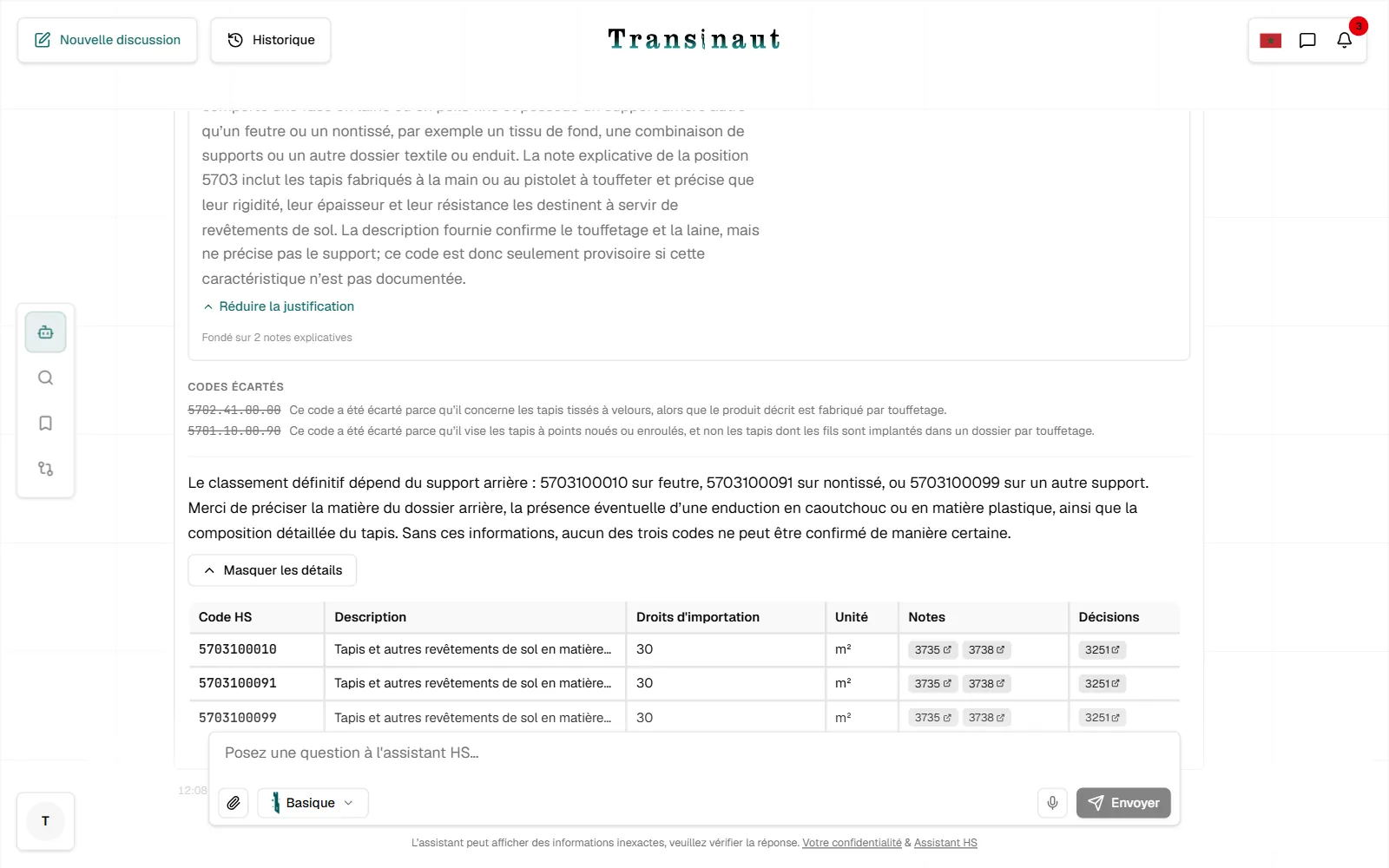
The assistant reads your description in plain language and proposes the Moroccan tariff codes that hold up — each one with its reasoning, its explanatory notes and the classification decisions behind it. You see the argument, not just the digits.
3 queries a month on the Free plan. No card required.
The products
that eat an afternoon.
An easy classification never takes ten minutes. It is always the same four situations that take three hours.
The product that fits nowhere
A table with an oak-veneered chipboard top and steel legs, shipped flat-packed. Three headings are arguable. Give the material, the function and how it is presented: the assistant lays out the candidates and says why each one holds or fails.
A catalogue of a hundred lines
A whole import to classify before the declaration. One conversation per product family, and the context stays put: "and if the top is glass?" is enough to get the variant, with nothing rewritten.
A photo and no spec sheet
The supplier sent an image and nothing else. Attach it with one line about the material: the photo shows the shape, it does not tell you the composition or the use. Together, the two are almost always enough.
The file you will have to defend
A post-clearance audit turns on notes and precedents, not on a hunch. Every proposed code arrives with its explanatory notes and classification decisions — enough to write the justification while you decide, not six months later.
One dense sentence,
one structured answer.
- 01
Describe the product in a sentence
Between 5 and 200 characters. The limit is deliberate: constituent material, function, form of presentation and state are what decide a classification. Country of origin, brand and price are not.
- 02
Pick how deep it should go
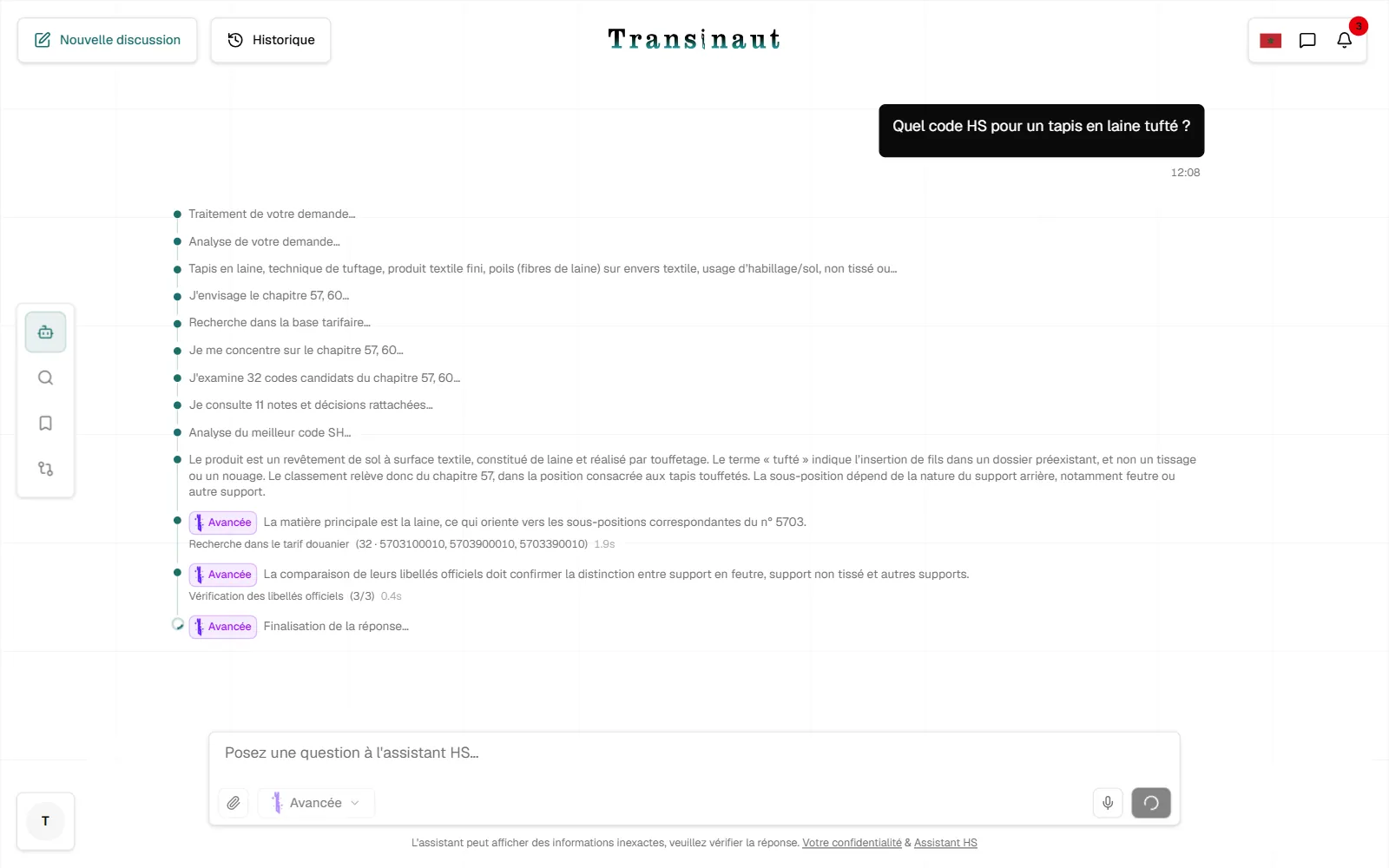
Basic answers in seconds on an everyday product. Advanced weighs several candidate headings across two passes. Expert goes all the way, for contested cases — and can take over a minute.
- 03
Read it, then narrow it down
One card per code, expandable reasoning, and a table of duties, unit, notes and decisions. Below it, short follow-up questions: one click sends them, and that is the fastest path from a 4-digit heading to a full code.
Four things,
done properly.
Three levels of search
Basic, Advanced, Expert. On the deeper levels the assistant shows its work — classifying, searching, reasoning, writing — and flags the second verification pass when it starts one.
Image classification
One image per message, 5 MB maximum, in PNG, JPEG, GIF, WEBP or SVG. Counted against its own quota, separate from text queries, from the Starter plan up.
Notes and decisions attached
Every justification cites the explanatory notes and classification decisions it rests on. Codes in the summary table are clickable and open the full official record.
History on your terms
Conversations resume with their full context. Retention is set to 30 days, 90 days, 1 year or unlimited, and the whole history can be wiped for good in one click.
The assistant supports the decision; it is not an official source. Three things it will not do for you.
- It does not declare on your behalf. The code you file remains your responsibility: read the complete official description before any customs or contractual use.
- It certifies nothing. An AI system can be wrong, including confidently. Complex or high-stakes cases should be validated by a qualified professional.
- It classifies against the Moroccan tariff only. The first six digits are universal; beyond them, a foreign 8- or 10-digit code does not transpose as-is.
Verify,
then decide.
Your first product classified in three minutes.
Create an account, describe a product, read the reasoning. If it does not hold up you will see that immediately — which is rather the point.
Free plan, forever · 3 assistant queries a month