Two defensible headings.
One to declare.
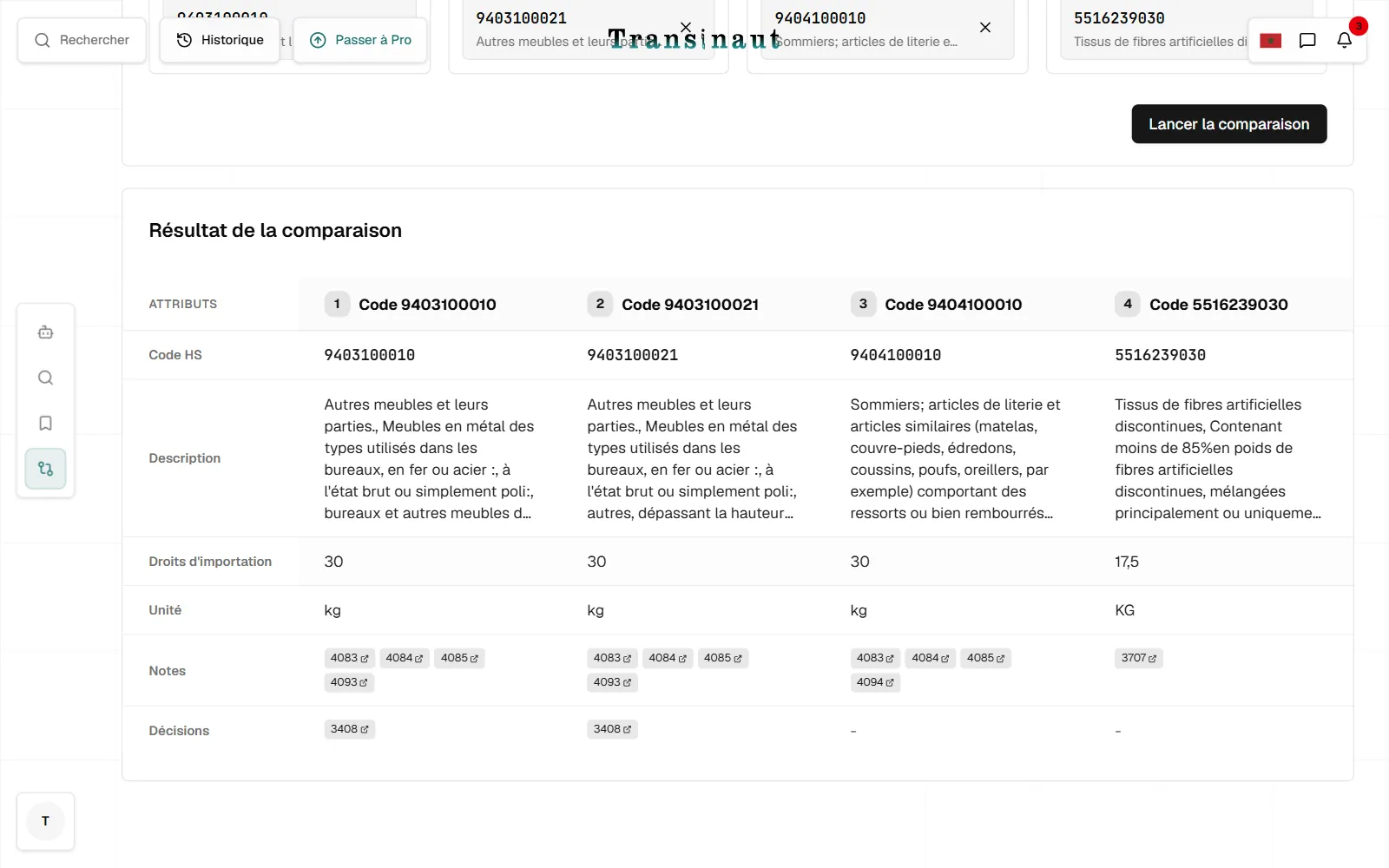
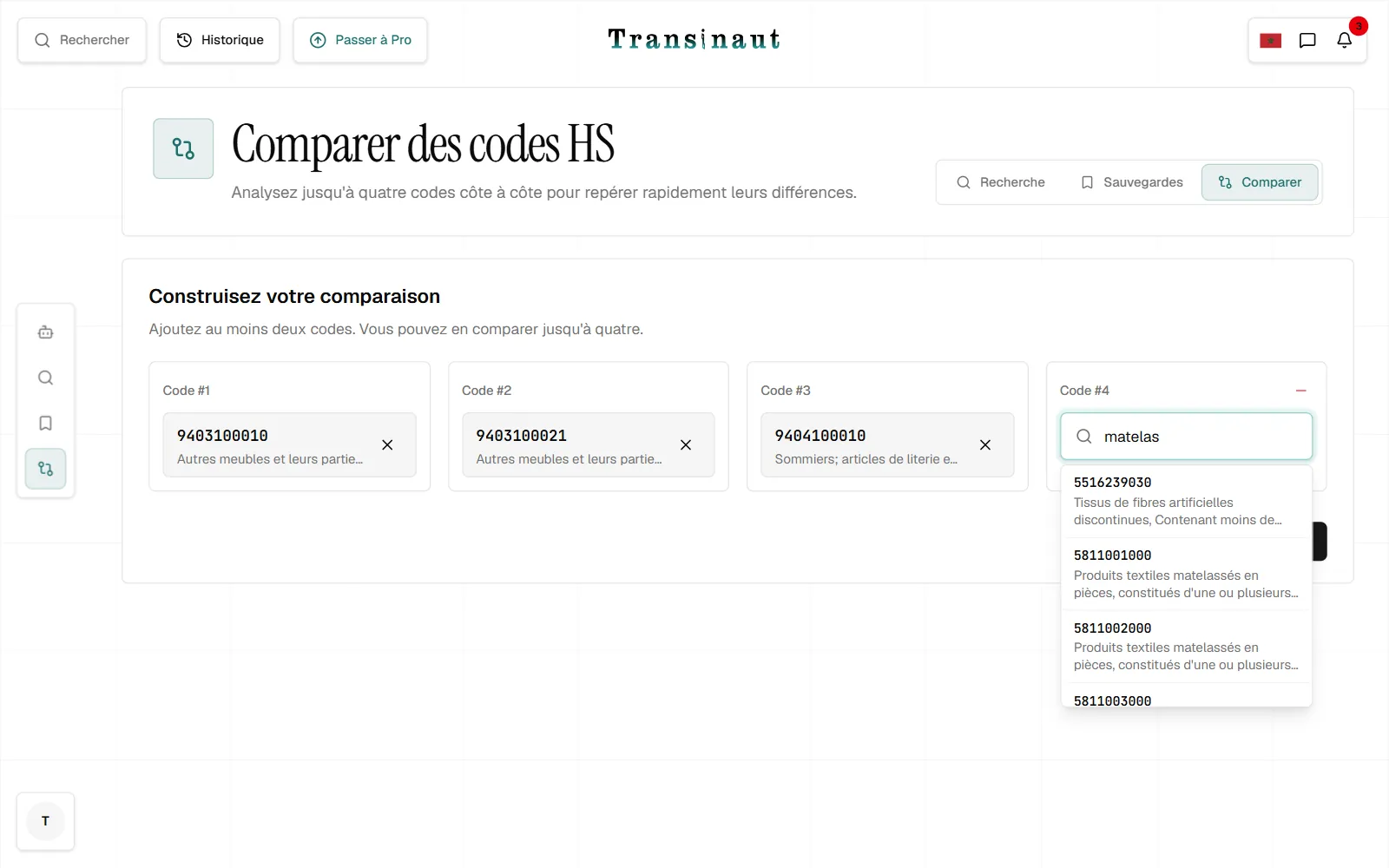
The comparator lines up two to four codes side by side, row by row: official description, import duties, unit, explanatory notes, classification decisions. The differences become visible at a glance.
Included in every plan, Free included.
The moment
two codes both hold.
Nobody opens a comparator out of curiosity. You open it when a call has to be made and neither candidate collapses on its own.
The assistant proposed several codes
Several cards mean several defensible classifications, offered as alternatives. It is the reasoning that separates them, not the display order — and reasoning reads better side by side.
Two wordings that differ by one word
"Put up in sets", "other than…": the distinction between two neighbouring headings often hangs on a phrase. Lined up on the same row, the two descriptions make the gap legible.
An inherited classification to test
The previous file used that code. Is it still right? Put it against the alternative and read both sets of notes: where they differ, the reason for the distinction is almost always there.
A product where the material decides
The same reference in solid wood and in chipboard does not land in the same place, and the duty gap is not trivial. Seeing both lines together beats discovering it at clearance.
Two codes are enough
to start.
- 01
Fill the first two slots
Each slot searches from 3 characters, on the digits of the code as readily as on words from the description. Two valid codes are enough to run the comparison.
- 02
Add up to two more
A third and then a fourth slot open on demand, and each can be removed on its own. A slot can be cleared and refilled at any time.
- 03
Read the table, row by row
Codes are clickable and open their full record in a new tab. A code that cannot be found is flagged in its own column without blocking the others.
The same rows,
for every candidate.
Up to four codes in parallel
Two minimum, four maximum. Past that the comparison stops being readable — and a serious fifth candidate usually means a piece of information about the product is still missing.
Duties and unit aligned
The rate and the unit of each tariff line, on the same row. A dash means a value is absent rather than zero.
Notes and decisions per column
The explanatory-note references and the classification decisions attached to each code. A decision on a product close to yours is the strongest argument you can bring.
Start from a code record
On any record, "Compare this code" opens the comparator with that code already in place. All that is left is to type the rival.
The table puts the facts side by side. It does not make the call, and three things keep that clear.
- Comparing is not deciding. The explanatory notes, the classification decisions and the general interpretative rules settle it — the table does not.
- The duty gap is not a selection criterion. The nature of the product determines the code; the rate is a consequence, never a reason.
- Comparing codes of different lengths teaches you nothing. A 4-digit heading and a 10-digit code are not read on the same plane.
Describe,
or verify.
Put your two candidates face to face.
The comparator is included in every plan. Once you settle on a code, save it with a note recording the one you rejected, and why.
Included from the Free plan · up to 4 codes in parallel