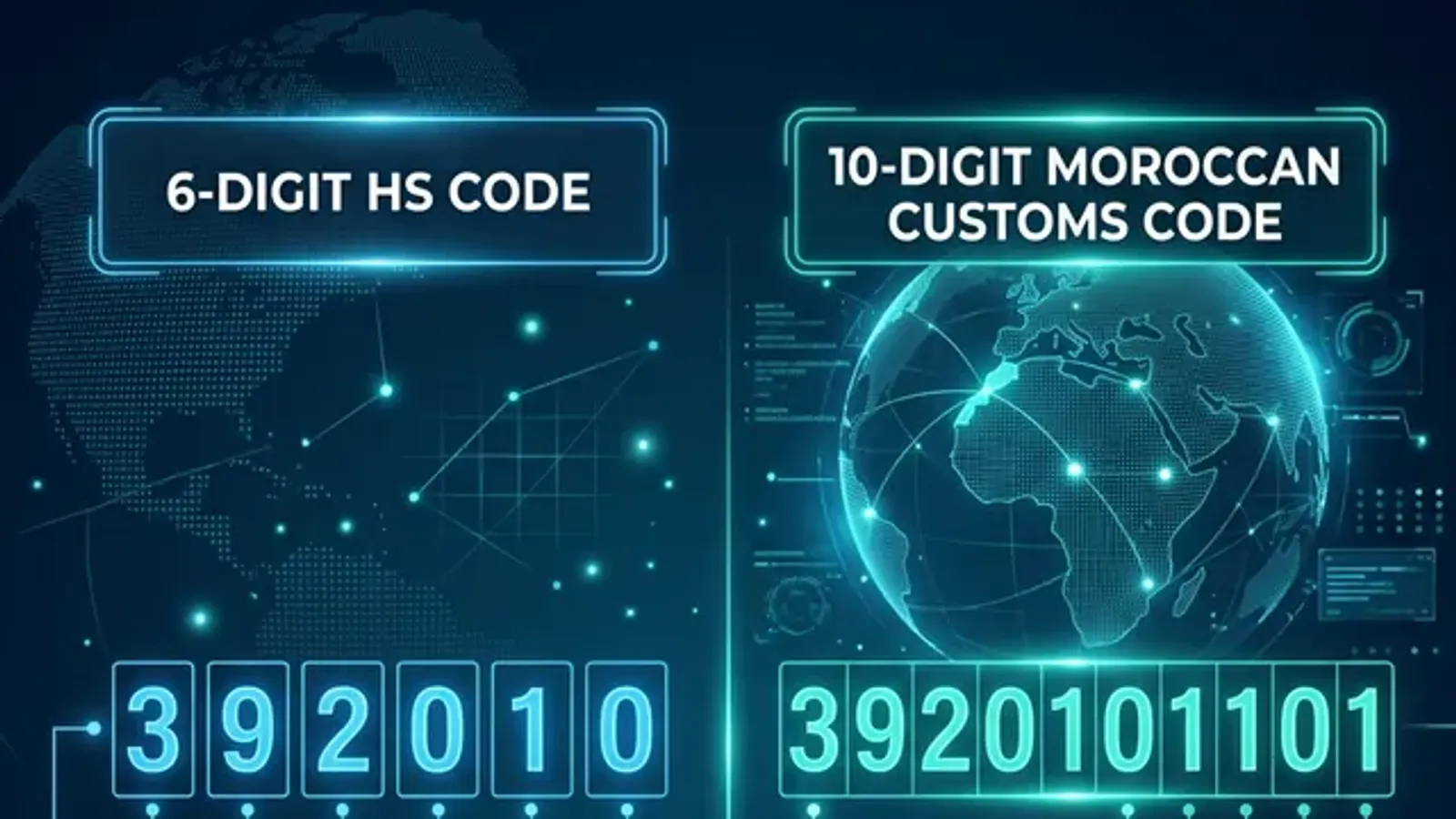
A six-digit code travels between countries. A ten-digit code is declared in one.
Your Chinese supplier sends you "8517.13". Your European customer replies "8517.13.00". Your Moroccan broker keys in "8517.13.00.00". All three are describing the same product, and only one of those codes can appear on a declaration.
This confusion is expensive because it is invisible: a six-digit code is syntactically valid everywhere and functionally unusable in Morocco.
What each segment adds
The first six digits are fixed by the WCO HS Nomenclature and bind Morocco under the HS Convention. Beyond that, each country is free: which is why a mapping between an eight-digit European code and a ten-digit Moroccan line is never automatic.
Six digits against ten, item by item
Six-digit subheading
Ten-digit national line
Authority
HS Convention — identical in more than 200 countries and territories.
Moroccan integrated tariff — valid in Morocco only.
Carries a rate
No. No duty attaches at this level.
Yes: import duty, and where applicable additional taxes.
Carries a unit
No.
Yes: supplementary unit of measure required at data entry.
Carries the measures
No: licences, controls and restrictions do not attach here.
Yes: technical control, authorisation, sanitary or trade-defence measure.
Usable on a declaration
No. A declaration cannot be lodged on six digits.
Yes. It is the only declarable level.
Usable for cross-country statistics
Yes: it is the only level comparable between countries.
No, unless you first fall back to the six-digit level.
Both levels are useful, but never for the same task. Comparing countries requires six digits; declaring in Morocco requires ten.
The facts that select the national subdivision
Descending from six to ten digits is not an administrative formality. It is a second classification decision, resting on product facts that were not needed at international level. Depending on the chapter, the national extension separates articles by material, destination, capacity, packing or degree of finish.
What you often have to produce to settle the last four digits
| Control point | Status | What you must be able to show |
|---|---|---|
| Capacity, power, dimension or unit weight | Required | The criterion behind many technical subdivisions in chapters 84 and 85. |
| Composition by percentage | Required | Decisive in the textile chapters for separating neighbouring lines. |
| Packing | Required | Bulk, retail packing, container capacity: a frequent criterion in food products. |
| Proven destination | Required | Some national lines are reserved for a documented use. |
| Extrapolation from a foreign eight-digit code | Blocking | Subdivisions do not correspond from one country to another. |
Walk two trees to the end
Take these two lines and read them from the bottom up: the national line, then the subheading, then the heading, then the chapter notes. That is the reverse of search order, and it is the order that best reveals what the national extension actually added.
8517130000Open the tariff record 8471300000Open the tariff recordWhat four digits are worth
Same six-digit subheading
A gap of 15 points
Two articles sharing their first six digits can therefore bear very different duties. That is exactly why a six-digit code allows neither costing a transaction nor comparing two suppliers on landed cost.
| Input | Formula | Result |
|---|---|---|
| Declarations over 12 months | BADR extract | 30 lines |
| Average customs value | Teaching assumption | MAD 100,000 |
| Rate gap between lines | 17.5% − 2.5% | 15 points |
| Duty exposure | 30 × 100,000 × 15% | MAD 450,000 |
From international candidate to declarable line
- 01
Fix the six-digit subheading
With the section and chapter notes and general rules 1 to 5. At this stage the reasoning is identical in every signatory country.
- 02
Open that subheading in the Moroccan tariff
Not in a foreign database. The number of national subdivisions and their criteria are specific to Morocco.
- 03
Apply GIR 6 at national level
Subdivisions are compared only with each other, at the same level. A ten-digit line is not compared with an eight-digit one.
- 04
Record the supplementary unit
It is carried by the line, it is mandatory at data entry, and it causes a large share of technical rejections.
- 05
Record the edition consulted
The code, the consultation date and the tariff version. A national line can be created, split or deleted without the first six digits moving.
Statistics are not read at the same level
Moroccan foreign-trade data is published at a level of detail that can go beyond six digits, but any international comparison has to come back down to six. The national series appear in Office des Changes statistics; series comparable between countries are available through UN Comtrade and the WTO tariff gateway.
Recheck codes at every edition change
An HS revision changes the first six digits of some lines; a national tariff overhaul can change the last four without touching the first six. The two events are independent and must be monitored separately. After each change, replay the decision on the articles concerned rather than applying the correspondence table unreviewed: a one-to-many correspondence forces a choice, and that choice is a classification decision in its own right.
Related articles
Calculating Moroccan customs duties by product
Import duty, the parafiscal levy and VAT do not share a base. The full cascade, the order of operations, and the documents that make the figure reproducible.
How to choose a customs broker and freight forwarder in Morocco
Comparing fees says nothing about the quality of a declarant. The mandate, the hard-file test, and the evidence they owe you back.
Classify a product catalogue with HS codes that stay maintainable
Classifying 4,000 references is not classifying 4,000 times. How to build families on stable attributes and handle the exceptions first.
The six customs valuation methods used in Morocco
The six methods apply in a fixed order, and the first covers nearly every case. What makes it fall away, and what comes next.