A declared 10-digit HS code is no guarantee of compliance. Verification is the step that separates careful importers from late ones.
You have an HS code from your supplier, or you found it yourself. How can you be sure it is right before declaring it to Moroccan customs? An error across 10 digits can mean unpredictable import duties, delays at the border, or worse: a fine for false declaration. This guide sets out how to check an existing HS code before you submit it to ADII (Customs and Indirect Taxes Administration).

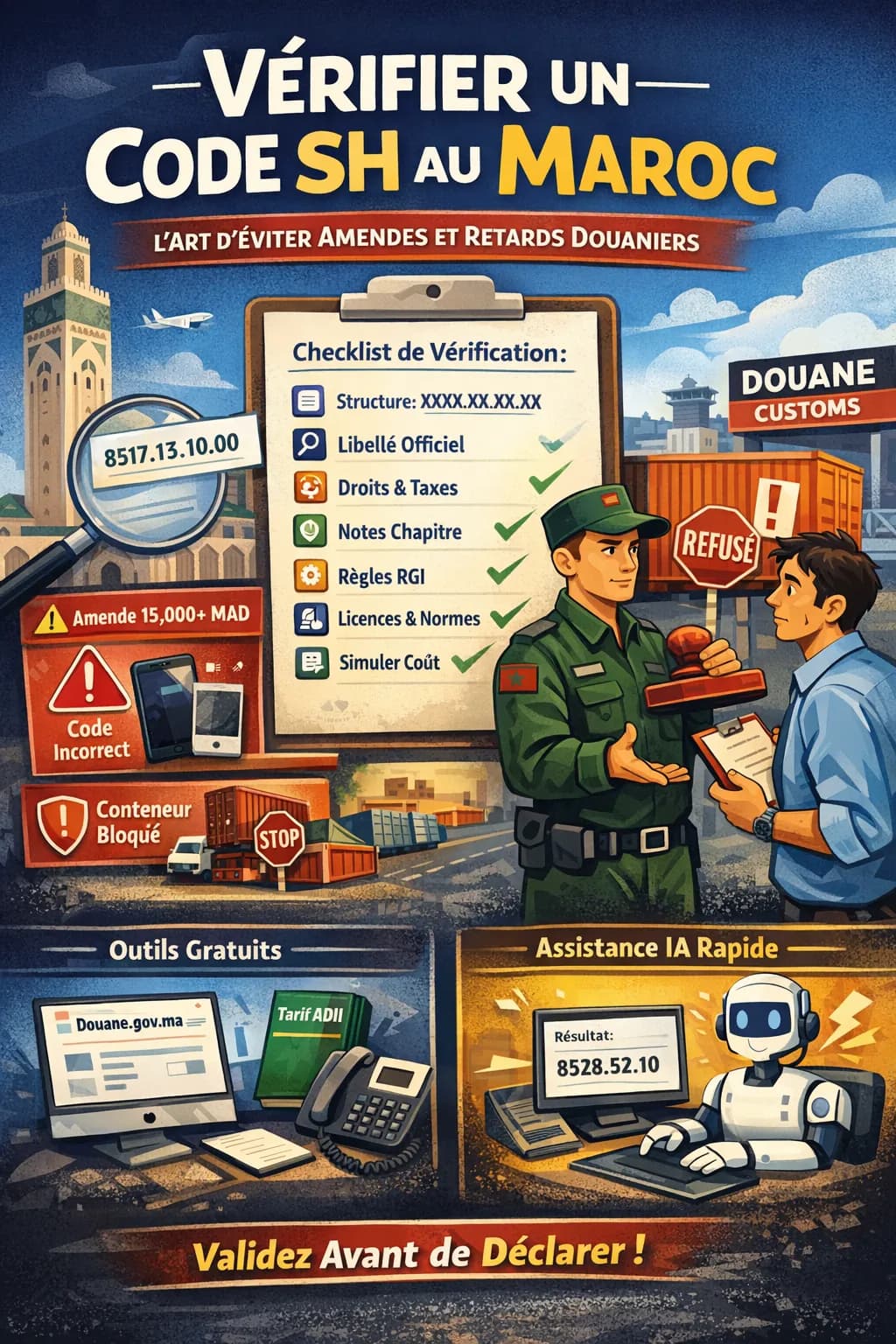
Step-by-step validation: check before you declare.
1. Why verification is critical
Under Moroccan law, the importer is responsible for the classification they declare. Not the supplier. Not the AI. YOU.
Scenario 1: code set too low
You declare 8517.13 (smartphones) when you are importing 8528.52 (monitors). Actual duty: 40%. Duty paid: 2.5%. Fine = 15,000+ MAD.
Scenario 2: code under a defence measure
You declare a product without realising it is subject to anti-dumping. The code exists but customs reject the declaration. Container held.
Cases where checking prevents the fine
- You have a code from an Asian supplier and do not know whether it applies to the Moroccan tariff.
- It is your first import of a given product type.
- The duty attached to the code looks abnormally low or high.
- You do not meet the conditions (an import licence, say) for importing under that code.
- It is a large order with serious money at stake.
2. The 7-step verification checklist
1Check the basic structure (10-digit format)
Does the proposed code follow the official format of the Moroccan Integrated Tariff?
XXXX.XX.XX.XX
- Chapter (XX): 01-99 (identifies the general category)
- Heading (XX): 00-99 within the chapter
- Subheading (XX): 00-99 (WCO nomenclature)
- National subdivisions (XX): 00-90 (specific to the Moroccan tariff)
2Read the code's official wording in the tariff
Does your product match the code's description exactly? That is GRI 1.
- Go to https://www.douane.gov.ma
- Download the Integrated Tariff for the current year (PDF or Excel)
- Look up the proposed 10-digit code
- Read the wording: "what exactly is your product?"
- Compare against the product's technical sheet: exact match, or a shade off?
3Check the import duties and taxes
Is the duty rate realistic for your kind of product? What to verify:
- Import duty (DI): normally between 0% and 40%. Above 40% is unusual (a safeguard measure).
- VAT: generally 20% in Morocco. Some products are exempt.
- TIC (Domestic Consumption Tax): applied to tobacco, alcohol, sugar, fuels. Look it up in the tariff.
- Anti-dumping: is the code listed in the measures currently in force?
4Check the section and chapter notes
A note can exclude your product from a chapter even when the wording seems to fit.
- Find the proposed chapter in the tariff.
- Read the "section notes" (at the start) and the "chapter notes" (at the start of that chapter).
- These notes carry essential inclusions and exclusions.
- A note may say: "does not include products X, Y, Z". Is yours among them?
5Apply the General Rules of Interpretation (GRI)
Could your product plausibly fall under 2-3 other codes? Which one do the GRI point to?
GRI 3c (the most commonly used) - where two codes both fit, take the one that comes last in numerical order. Example: 8507.20.11 vs 8507.20.19 → choose 8507.20.19 if both fit.
GRI 1 (the strictest) - classification is determined by the exact wording. If the wording does not describe your product, it is the wrong code.
GRI 2a (incomplete products) - if you are importing a kit or loose parts, look for the code of the finished product, not the parts.
6Check the import conditions (licences, standards, controls)
Some codes require special authorisations (ONSSA, Ministry of Industry, and others). Questions to ask:
- Does the code fall in a regulated sector (food, pharma, sensitive electronics)?
- Do you need a certification (ISO, Moroccan standards) to import under it?
- Must ONSSA (National Food Safety Office) inspect the product?
- Is the code subject to specific measures (a quota on certain textiles, for instance)?
7Simulate your declaration (duty calculation)
Before declaring, work out roughly what duty and tax the proposed code implies. Does the result look reasonable?
Declared value = USD 1000
DI = 25%  →  Duty = 250 USD
VAT = 20% (taxable base = 1000 + 250)  →  VAT = 250 USD
Total payable ≈ 500 USD (27,500 MAD)
If that looks out of proportion to your product, reconsider the code.
3. Real cases: common errors and how to avoid them
Case 1: confusing 6 and 10 digits
Scenario: the supplier gives you "8517.13" (6 digits). You declare it as is in Morocco.
Problem: Morocco requires 10 digits. You have to extend it to 8517.13.XX.XX - but to which? Without the last 4 digits, customs reject your declaration. The container waits until it is cleared up.
✓ Fix: always check the supplier's code has exactly 10 digits before declaring.
Case 2: electronics under anti-dumping measures
Scenario: you classify electrical transformers under 8504.40, which looks right. ADII refuses: that code is subject to a temporary anti-dumping measure (2026-2028).
Impact: you need a certificate of origin, a special import licence, and an additional anti-dumping duty (+45%, say).
✓ Fix: before declaring, check the ADII list of measures IN FORCE (douane.gov.ma).
Case 3: a chapter note overlooked
Scenario: you classify copper sheets under chapter 74 (copper). Customs refuse and reclassify them under chapter 75 (nickel/copper alloy).
Reason: you had not read the chapter 74 note: "does not include copper alloys". Your product contained 15% tin.
✓ Fix: read the notes systematically and in full before accepting a code.
Case 4: food product without ONSSA certification
Scenario: you import under code 2106.90.91 (various food preparations) without requesting a prior health inspection.
Impact: customs hold the container for ONSSA inspection. Wait: 5-10 days. Demurrage: 1,000+ MAD/day.
✓ Fix: for food codes, request ONSSA inspection BEFORE importing. Planning ahead means shorter delays.
4. Verification tools (free & paid)
Free resources
- 🌐 Official ADII tariff - www.douane.gov.ma
- 📋 WCO HS database - international codes (6 digits) with definitions.
- ✉️ ADII consultation service - send a formal request, get an answer in 2-10 days.
- 📞 Customs hotline - +212 5373-77000 (urgent questions out of hours)
Accelerators (paid / AI)
- 🤖 AI assistant (Transinaut) - give it the product description, get a code plus confidence score in 5 seconds.
- 🔍 Advanced tariff search - filter by import duty, by TIC, by defence measures.
- 📊 Advance RTC - a formal request to ADII produces a binding ruling (15-30 days).
Manual verification
- ✓ Free (your own time)
- ✓ Complete and detailed
- ✗ Very time-consuming
- ✗ Open to human error
Automated verification
- ✓ Fast (seconds)
- ✓ Reliable and consistent
- ✓ Scales to thousands of codes
- ~ Requires investment
5. When to request Binding Tariff Information (RTC)
An RTC is a formal request to ADII for a BINDING ruling, FREE of charge and valid for 3 years, on a product's classification. That ruling protects you legally.
An RTC is worth it if:
- The product is unusual or new (a drone, a special Li-Po battery)
- The code sits borderline between 2-3 options
- Volumes are very large (> 100 containers/year)
- The import duty is high (> 20%)
- It is your first import of this type into Morocco
An RTC is probably unnecessary if:
- The product is very standard (a t-shirt, a shoe)
- The AI score is > 90% with a reliable code
- Volumes are small (< 10 containers/year)
- The duty is low (< 5%)
How to request an RTC
- Prepare a file: detailed description + photo + technical sheet
- Send it to ADII headquarters (Rabat) or your local customs office
- Reference it: "RTC request for product [description]"
- Wait 15-30 days (typically)
- You receive a written ruling valid for 3 years
FAQ: HS code verification
Who is responsible if the code is wrong?
The importer. You are the one signing the DUM (Single Goods Declaration). Customs can pursue the importer, not the supplier or the AI. That is why verification matters.
Will customs change the code at the border?
They can. If the officer judges your code wrong, they can correct it and bill you the difference in duty plus penalties. Better to be right from the start.
Does the HS code change every year?
Yes. The international versions (6 digits) are reviewed every 5 years. Moroccan national versions (10 digits) can change annually in January. Check your code each year before the import season.
Can I request a retroactive RTC?
No. An RTC applies going forward. If you have already declared and customs challenge you, you cannot request one to put it right. Which is exactly why you check BEFORE declaring.
How much does an RTC cost?
Nothing. RTCs are free in Morocco. The only "cost" is your time, and possibly a customs consultant's if you want a second opinion.
Articles recommandés
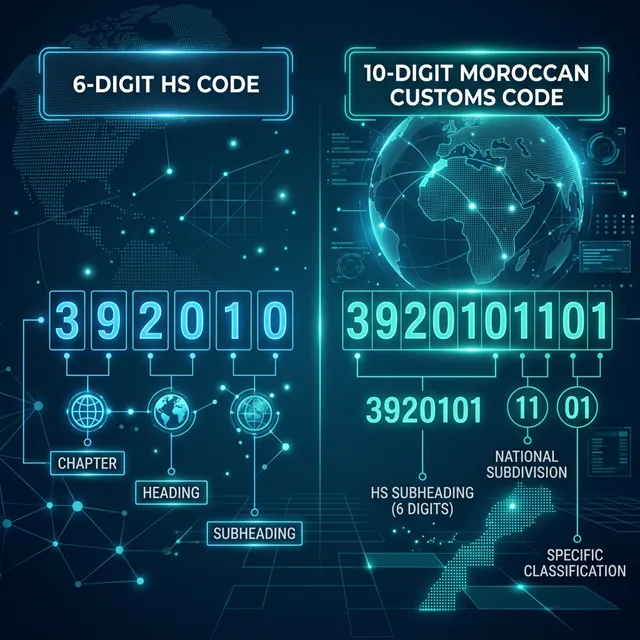
HS code 6 vs 10 digits in Morocco: what is the difference?
Understanding the distinction between the international nomenclature (6 digits) and the Moroccan national tariff (10 digits) to keep your imports safe.

How to find your HS code in Morocco in 2026 (manual method vs AI)
A complete guide: manual search in the Integrated Tariff, AI assistance, when to trust it, and the traps to avoid.
HS code error: reassessment, fine and how to challenge it
What an importer really risks from a wrong HS code in Morocco: reassessment, surcharges, post-clearance audit, and the procedure for challenging it.