Hunting manually for an HS code across the 21,000 lines of the Moroccan Integrated Tariff is like looking for a needle in a haystack with your eyes shut.
You have a product to import into Morocco. You have a technical sheet. What you do not have is the exact 10-digit HS code Moroccan customs needs. How do you find it? Two roads are open: the traditional method (long, tedious) or intelligent assistance (fast, precise). This guide walks through both, the traps in each, and how to know when to trust the AI.
A direct methodology: from the product to the exact classification
1. The manual method: the 4 unavoidable steps
If you decide to look up the HS code yourself, this is the process customs professionals follow. It is methodical, but it can take 30 minutes to several hours depending on how complex the product is.
1Identify the raw materials and characteristics
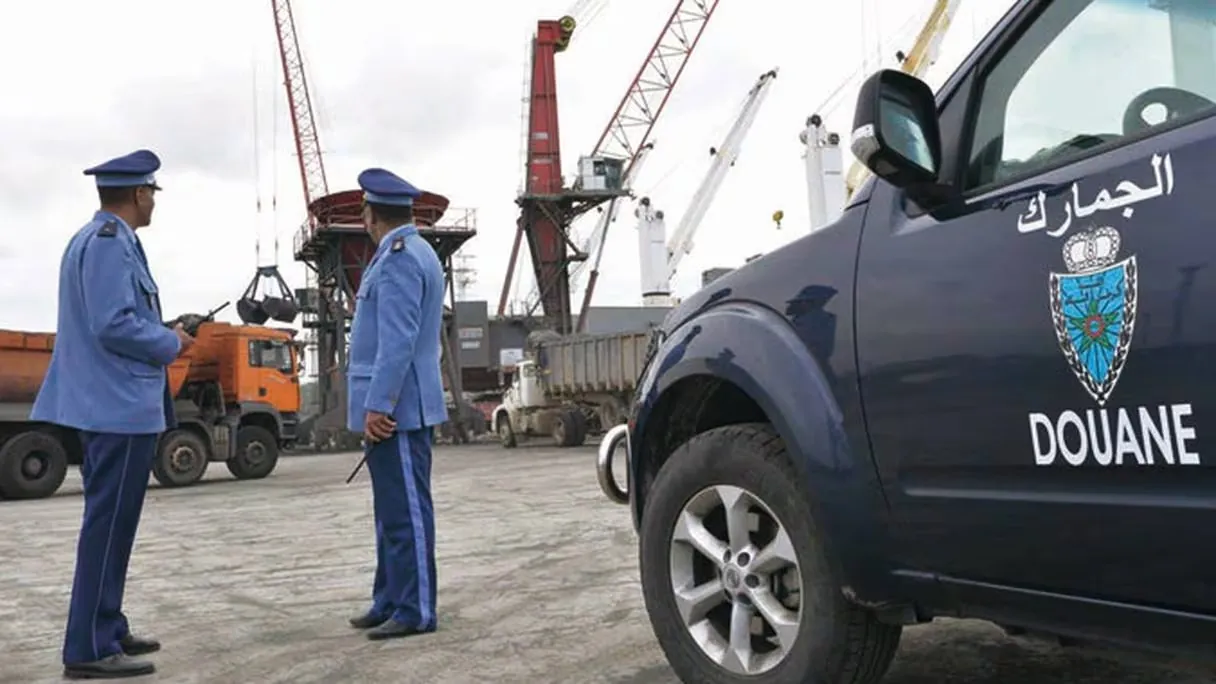
Before looking for a code, you need to understand your product thoroughly. ADII (Customs and Indirect Taxes Administration) officers in Morocco do exactly this during inspections.
- Composition: steel, plastic, rubber, fabric? The dominant material often determines the chapter.
- Use: the same product can be classified differently depending on its application (a water pipe versus a chemical-industry pipe).
- State: finished, semi-finished, raw? Semi-finished goods often have headings of their own.
- Dimensions/weight: for some products, weight or size thresholds change the classification (electrical wire, for instance).
2Consult Morocco's Integrated Tariff (the official document)
The Moroccan Integrated Tariff is published by ADII. It is a PDF running to several thousand pages, containing every 10-digit code with its duty rates and applicable measures.
You open the PDF. You look for the chapter that matches your product (chapter 85 for electronics, chapter 39 for plastics). Then you work down the hierarchy (heading → subheading → 10-digit national code).
3Apply the General Rules of Interpretation (GRI)
You may well have found 2 or 3 candidate codes. Now you apply the GRI to decide. This is where many operators go wrong.
GRI 3c, "the last one wins": where two codes are equally relevant, you take the one that comes last in numerical order. It is a universal convention.
GRI 2a, "incomplete products": if your product is unfinished (loose parts), you look for the code of the finished assembly, not each part individually.
4Read the section/chapter notes
This is the step 80% of operators skip. Section and chapter notes can exclude your product from a chapter outright, even when it looks like it belongs there.
2. The traps in the manual method
Mental fatigue and errors
After 30 minutes reading a 4,000-page PDF, your eyes tire. The codes start to look alike. It is easy to confuse 8516.50.10 with 8516.50.90.
Excessive search time
For a simple product, 15 minutes. For one with mixed characteristics? 1-2 hours. At 100-200 products a month, you burn hundreds of hours.
The section notes are dense
They are written in strictly legal language, full of implicit exclusions and inclusions that only customs training lets you catch.
The annual update, forgotten
The tariff changes every year. A code valid in 2025 can be deleted or merged in 2026, and you end up working from stale data.
3. The AI-assisted approach: faster, with caveats
An AI trained on the Moroccan Integrated Tariff can scan all 21,000 lines instantly and propose the most likely code. It looks like magic, but there are important nuances.
How does AI classification work?
- Feature extraction - the AI reads the product description and identifies materials, use, form and dimensions.
- Analogy search - it looks for known codes for similar products in its database.
- GRI checking - it validates that GRI 1 (exact wording) or the other rules are respected.
- Proposing the 10-digit code - with a confidence score showing how certain it is.
What AI gives you
- Speed: under 10 seconds for a classification.
- Consistency: it applies the same rules every time, without tiring.
- Learning: correct it, and it refines its models for future predictions.
- Scale: 100 products or 10,000, the time stays roughly constant.
What AI cannot do
- Hybrid products: it can hesitate between two neighbouring codes when the characteristics really are mixed.
- Vague descriptions: give it too little detail and it guesses, and guesses can be wrong.
- New categories: genuinely novel products (drones in 2015, say) are not in the training data.
- No legal substitute: the AI proposes a classification, but YOU answer to customs. If the AI is wrong, the fine is yours.
4. When to trust the AI, and when to check by hand
Trust the AI when:
- The confidence score is > 85% (the AI is sure of itself).
- It is a standard, well-known product (a phone, a t-shirt, a tin of food).
- You have historical data: the AI has classified this product successfully before.
- The import duty stays low (< 10%), so the financial risk of an error is limited.
Check by hand if:
- The score is between 50-70% (the AI is unsure).
- The product is made of several materials (two textiles sandwiched with metal, for instance).
- The customs duty goes above 20% - check first.
- It is your first import into Morocco, or your first of this product type.
- The proposed code is subject to defence measures (anti-dumping): these cases are sensitive.
5. A worked example: classifying a lithium-polymer battery
You want to import lithium-polymer batteries for your electronics. The technical sheet says: "Li-Po battery, 2200mAh, 3.7V, protection circuit, ABS plastic".
The manual approach
- You open chapter 85 (electrical, primary cells and accumulators).
- You find heading 8507 (electric accumulators).
- You go down: 8507.10 (primary), 8507.20 (secondary). Your rechargeable Li-Po battery falls under 8507.20.
- You read the subheadings: 8507.20.11 (Li-ion), 8507.20.19 (other secondary).
- The question: is lithium-polymer Li-ion, or "other"? Ambiguous. You read the notes.
- The chapter 85 notes are not much help.
- You call ADII to ask. The answer: "Send us the full technical sheet and we will get back to you in 2 days." You wait.
- Elapsed time: 2-5 days.
The AI approach (Transinaut)
You describe the battery to the assistant. The AI works through it:
- Material: lithium-polymer → a modern Li-ion technology.
- Use: rechargeable, stores energy → secondary accumulator.
- Capacity: 2200 mAh, 3.7V → small battery, not an industrial one.
- Conclusion: 8507.20.11.00, confidence: 92%.
Elapsed time: 5 seconds.
Manual approach
- ⏱️ Duration: 30 min - 2 hours
- 👤 Requires a person
- ⚠️ Error risk: 15-20%
- 💰 Cost: the operator's salary
AI approach
- ⚡ Duration: 5-10 seconds
- 🤖 100% automated
- ✓ Reliability: 85-95%
- 💰 Cost: per-use or subscription
FAQ: your questions on classification
Can the AI get the national code (digits 7-10) wrong?
Yes. Digits 7-10 reflect national policy on import duties and taxes. They are less standardised than an international HS code. That is why the AI gives a confidence score. Above 85% on the 10-digit code is generally reliable for standard products. For borderline cases, checking with ADII is recommended.
What if customs challenge the AI's classification?
That is your responsibility, not the AI's. Customs can ask you to justify your code. If the AI got it wrong, you face the penalties. That is exactly what the confidence score is for: use it to decide whether to check by hand.
Do I need Binding Tariff Information (RTC) before every import?
No. An RTC is a formal request to the administration (ADII) for an official ruling on classification, and it takes 15-30 days. You only need one if: (1) the product is unusual or new, (2) the AI's score is low (< 60%), or (3) you are importing large quantities at a high duty rate and want a legal guarantee.
Does the HS code change every year?
Yes. The 6-digit codes (WCO level) change every 5 years. Moroccan national codes (digits 7-10) can change annually when the Integrated Tariff is revised, usually in January. The AI has to be updated regularly to stay accurate.
What exactly does a bad classification cost?
If you declare a code at 10% duty when the correct rate was 25%, customs collect the unpaid tax plus fines (often 50-100% of the amount avoided) and can suspend your activity. In Morocco, a deliberate "false declaration" is treated as a serious customs offence.
Articles recommandés
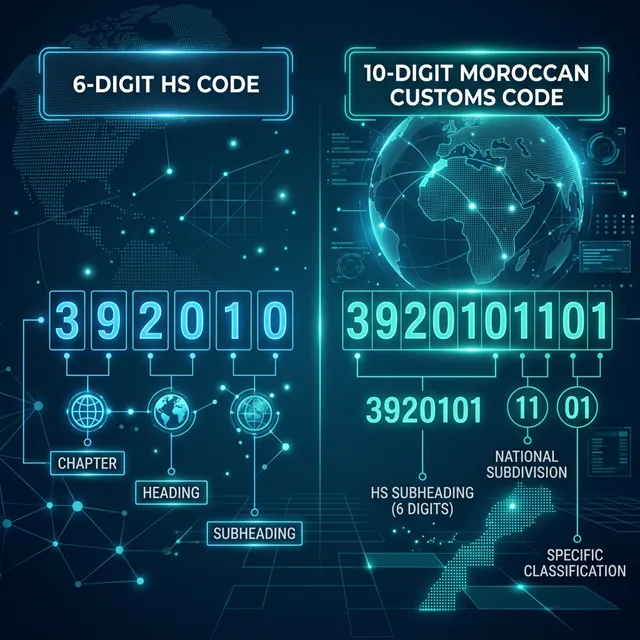
HS code 6 vs 10 digits in Morocco: what is the difference?
Understanding the distinction between the international nomenclature (6 digits) and the Moroccan national tariff (10 digits) to keep your imports safe.
The complete guide to HS codes in Morocco (Customs 2026, 6 and 10 digits)
Everything you need to know about HS code structure in Morocco, the 10-digit specifics, and how to avoid classification mistakes.